


Hallacas
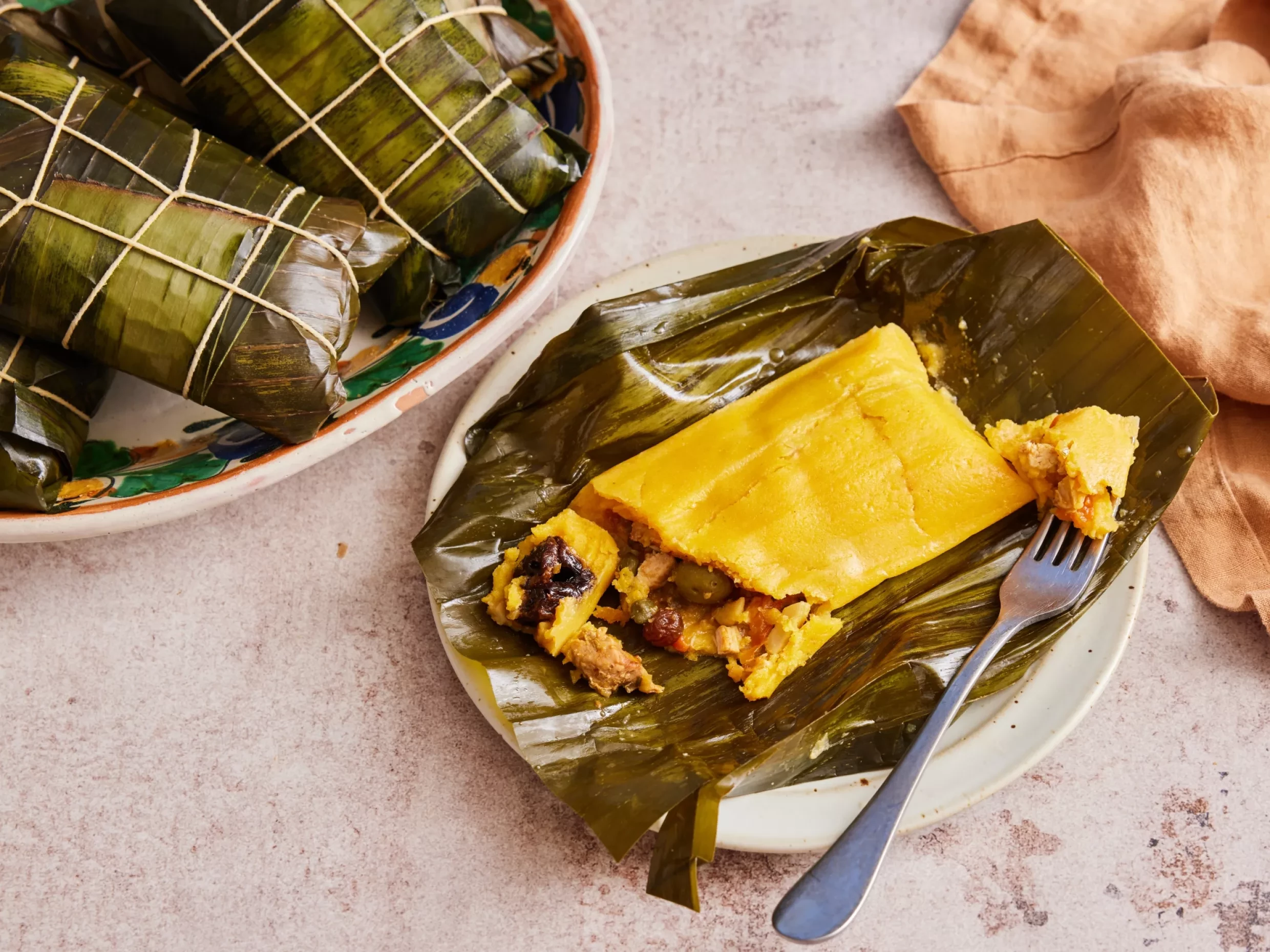
"Hallacas are a Venezuelan Christmas tradition. Put simply, cornmeal masa gets folded and stuffed with a meaty stew and a couple of garnishes. However, unlike most other traditions, this one seems to be a national requirement. Every Venezuelan family that I know gathers in early December to divide up the work, celebrate family and the holiday season. We make hundreds to eat through December, having them for dinner every Christmas Eve, Christmas Day and New Year’s. What makes hallacas even more special is that the contents vary across families and regions. My dad’s mother, Abuela Chabe, whose seasoning is in this recipe, makes her stew with just pork and adds potatoes and chickpeas to it. The region where my mom’s mother, Abuela Josefina, is from is known for not cooking the stew before adding it to the masa. It took me two Christmases to convince my mother to let us add a second plum, as it is one of my favourite bites. All this is to say: Every family has an evolving recipe that is distinctly theirs. This is ours."
Related Recipes
Ingredients
Guiso (Stew):
Chicken:
Plantain Leaves:
Masa:
Assembly:
Abuela Chabe's Adobo:
Method
Special equipment: a multi-cooker or pressure cooker
- For the guiso: Heat 60ml of the oil in a large, heavy-based saucepan over a medium heat until hot. Add the onions and a large pinch of salt. Cook over a medium-low heat, stirring occasionally, until the onions start to become translucent and release their liquid, about 10 minutes.
- Add the diced peppers, adobo and stock cubes. Add another 60ml oil if the bottom of the pan looks dry. Cook, stirring occasionally, until the peppers start to break down and the mixture resembles a dark red-orange soup, about 10 minutes. Keep the heat low enough, and use enough oil, to prevent anything sticking to the bottom of the pan.
- Add the leeks, spring onions, 3 tablespoons salt and the remaining 60ml oil, if necessary. Cook, stirring occasionally, until the vegetables break down, about 10 minutes. Add the garlic and capers and continue to cook, stirring occasionally, until the mixture resembles a slaw tossed in a bright brick-red barbecue sauce with some oil, about 10 minutes.
- Once the vegetables have softened and formed a homogeneous mixture, add both wines, the mustard, Worcestershire sauce and dissolved panela and stir together. Bring to the boil, then reduce the heat to a simmer. Taste and add more salt if necessary.
- Add the pork and beef to the vegetables, stir to combine and bring to a very gentle simmer. Cover and cook for about 15 minutes. The beef and pork will have released some juices, so stir to combine everything evenly and redistribute some of the meat from the bottom of the pan to the top.
- Cover and cook over a low heat for another 30 minutes. Check every 5–10 minutes; if the mixture is bubbling vigorously, reduce the heat so the meat doesn’t become tough. After 30 minutes, taste a piece of beef. It should be tender and fall apart when bitten. If it is still a little tough, cook for another 5–10 minutes.
- If making the hallacas all in one day, transfer the guiso to a bowl so it cools more quickly. If spreading the process over a couple of days, divide the guiso between smaller containers, leave to cool slightly, then cover and refrigerate overnight.
- For the chicken: Put the chicken into a multi-cooker or pressure cooker (see Cook’s Note). Add 1.65 litres water, the stock cubes, a large pinch of salt and the reserved leek tops. Following the manufacturer’s instructions, lock the lid and prepare the cooker. Select the medium meat setting and switch off the Keep Warm function, if available. If there is no meat setting, or you are using a standard pressure cooker, pressure cook for 15 minutes.
- Once the cooking cycle has finished, follow the manufacturer’s instructions for a natural pressure release and wait until the cycle is complete.
- Transfer the chicken to a medium bowl and leave to cool slightly. Strain the liquid into a large saucepan and reserve 1.65 litres for the masa. Tear the chicken into roughly 5mm pieces and set aside for the garnish.
- For the plantain leaves: While the guiso and chicken cool, carefully rinse the plantain leaves. Open them out until you reach the centre and have one smooth leaf. Divide the leaves into three categories: mains, supporters and strips – or las primeras (the firsts), las segundas (the seconds) and las fajas (the strips).
- The main leaves will directly touch the masa and will be used to fold the masa over itself, so they need to be strong and free from holes. Cut each main leaf into a rectangle about 38cm long, each supporting leaf about 33cm long and each strip ideally 7.5–10cm wide. You will need at least 25 of each.
- Sort the leaves into three piles according to size, then gently wipe each one dry with a cloth and remove any remaining dirt.
- Wrap two chopping boards in cling film: one large rectangular board that is bigger than the largest leaf rectangle and another measuring about 25cm across. These will act as a masa press. Wrapping them in cling film helps the dough release easily and prevents staining.
- You will also need a muñequita (“little doll”), which is a clean cloth used for greasing the plantain leaves. Take a clean cloth or piece of muslin and form a small ball about 4cm wide at one end. Tie it off with kitchen string, leaving enough fabric to use as a handle.
- For the masa: Add 3 tablespoons salt to the saucepan containing the chicken stock and heat over a medium heat until warm, 2–5 minutes. It should taste like a well-seasoned chicken soup, as this will season the masa.
- Meanwhile, heat the oil and 2 tablespoons of the annatto seeds in a small saucepan over a medium heat until the oil turns a deep red-orange, about 2 minutes. Keep an eye on the seeds to make sure they don’t darken and burn. Be aware that annatto oil stains, so wear gloves when handling the oil and dough.
- Strain the annatto oil into the warm chicken stock and stir to combine. Return the seeds to the small saucepan and set aside.
- Working in sections, add about 240ml of the annatto stock to one side of the cornmeal in a large bowl. Knead the liquid into that section of cornmeal using gloved hands. Taste a little of the dough and add more salt to the stock if necessary.
- Rotate the bowl, add another 240ml stock and repeat twice more, incorporating the stock into the drier parts of the dough each time. You should have incorporated about 950ml stock at this point. Bring the sections together and knead.
- Once there are no visible grains of cornmeal remaining, combine the dough evenly before adding more stock. Knead it into a large ball, flatten it against the bottom of the bowl and make holes throughout so the additional stock can penetrate the dough rather than running straight to the edges.
- When you have about 700ml stock remaining, transfer the dough to a large roasting tin and continue kneading there. Avoid working directly on a worktop or chopping board, as the annatto can stain.
- Continue working the dough together, making holes and adding about 120ml stock at a time, up to five more times. You probably won’t need the final 120ml, but it is useful to have it available.
- The dough should become wet enough to stick slightly to the bottom of the tin, but once kneaded and the liquid has been absorbed, it should come cleanly away from your hands and the tin. Take a handful of dough, roll it into a ball and flatten it. If cracks appear around the sides, add a little more liquid. If there are no cracks, it is ready. The texture should be very soft and pliable, similar to modelling clay.
- Weigh the dough and divide it into 25 equal portions. Each portion should weigh about 105–112g and should not be less than 100g. Roll each portion into a smooth ball, then cover with a damp, dark-coloured tea towel to prevent the dough from drying out.
- For the assembly: Add the vegetable shortening and remaining 2 tablespoons annatto seeds to the reserved annatto seeds in the small saucepan. Heat over a low heat until the shortening melts and turns a deep red colour, about 5 minutes. Remove from the heat. If the shortening starts to solidify while assembling the hallacas, gently reheat it until smooth.
- Cut kitchen string into 25 lengths, each about 130cm long.
- Set up four stations: one for flattening the dough with the cling film-wrapped chopping boards, annatto shortening, muñequita, main plantain leaves and a stack of plates; one for filling with the guiso, pepper slivers, chicken, raisins, almonds, capers, olives, bacon and dried plums; one for wrapping with the supporting plantain leaves and strips; and one for tying with the kitchen string.
- Bring a large saucepan of water to the boil.
- Place a main plantain leaf, smooth-side up, on the larger cling film-wrapped chopping board. Holding the muñequita by its handle, dip the ball into the melted shortening and generously grease a 23cm circle in the centre of the leaf.
- Put a ball of masa in the centre and press with the smaller chopping board until you have a circle about 20cm in diameter. Transfer the leaf and flattened dough to a plate.
- Add just under 120ml guiso in a straight line across the masa, aligned with two opposing diagonal corners of the leaf and leaving about 2.5cm clear on either side of the dough.
- Place one pepper sliver along each of the long edges of the filling. Add a four-finger pinch each of chicken, raisins, almonds and capers, in that order. Top with 2 pieces of bacon, 4 olive halves and 2 dried plums, placing one plum at each short end.
- Take one corner of the leaf perpendicular to the line of filling and fold it over, gently peeling the masa away from the leaf so that it covers half the filling lengthways. Repeat on the other side so that the masa overlaps with the first half and the two sides meet in the middle.
- You should now have a rectangle of masa, rounded at the short ends and positioned diagonally in the centre of the plantain leaf. Using the short sides of the leaf, bring the corresponding sides of the masa inwards to cover any exposed filling. Carefully peel the masa away from the leaf and pat down the short sides so that the dough sticks to itself and completes the rectangle. Ideally the filling should be completely covered, but don't worry if a little remains visible.
- Wrap the dough in its main plantain leaf as you would a present. Fold one corner towards its diagonally opposite corner, creating a crease at the bottom. Repeat on the other side to enclose the dough lengthways, then fold the two short sides over to create an open envelope with a triangular flap.
- Close the envelope by tucking the triangular flap underneath until you have a neat rectangle. Place the parcel flap-side down in the centre of the smooth side of a supporting leaf, positioned diagonally.
- Wrap the rectangle securely, paying particular attention to the edges to prevent water getting into the masa. Trim off any protruding triangular flap. Place a strip of plantain leaf over the final opening and wrap it crossways around the centre of the parcel to complete the seal.
- Tie the hallaca like a parcel. Use two rows of kitchen string running both lengthways and crossways to create a 3 x 3 grid.
- Repeat with the remaining hallacas.
- Cook the hallacas in rapidly boiling water until the aroma of the plantain leaves fills the kitchen, at least 1 hour.
- Any uncooked hallacas can be frozen in sealed freezer bags for up to 6 months. To cook from frozen, boil in batches for 1 hour 15 minutes–1 hour 30 minutes.
- Once cooked, remove the hallacas from the water using tongs or a large slotted spoon and carefully open the leaves. They will be very hot. If the leaves have been well greased, the hallacas should release easily. Place seam-side down on serving plates, if possible, and serve immediately.
Abuela Chabe’s Adobo
Mix all the ingredients together in a small bowl. Use to season chicken, beef, pork, rice, vegetables or grains. Makes about 2 tablespoons.
Cook’s Note
A mixture of port and Marsala is traditionally used in this recipe, but if you only have one, use 180ml of either.
For 25 hallacas, start with about 2kg meat. This recipe uses approximately 1.1kg beef and 900g pork, but you can adjust the proportions according to your preference.
Cooking the chicken provides both one of the fillings and the stock needed for the masa. You can braise or pressure cook the chicken, but make sure you use enough water to have at least 1.65 litres of stock remaining for the masa.